

Description
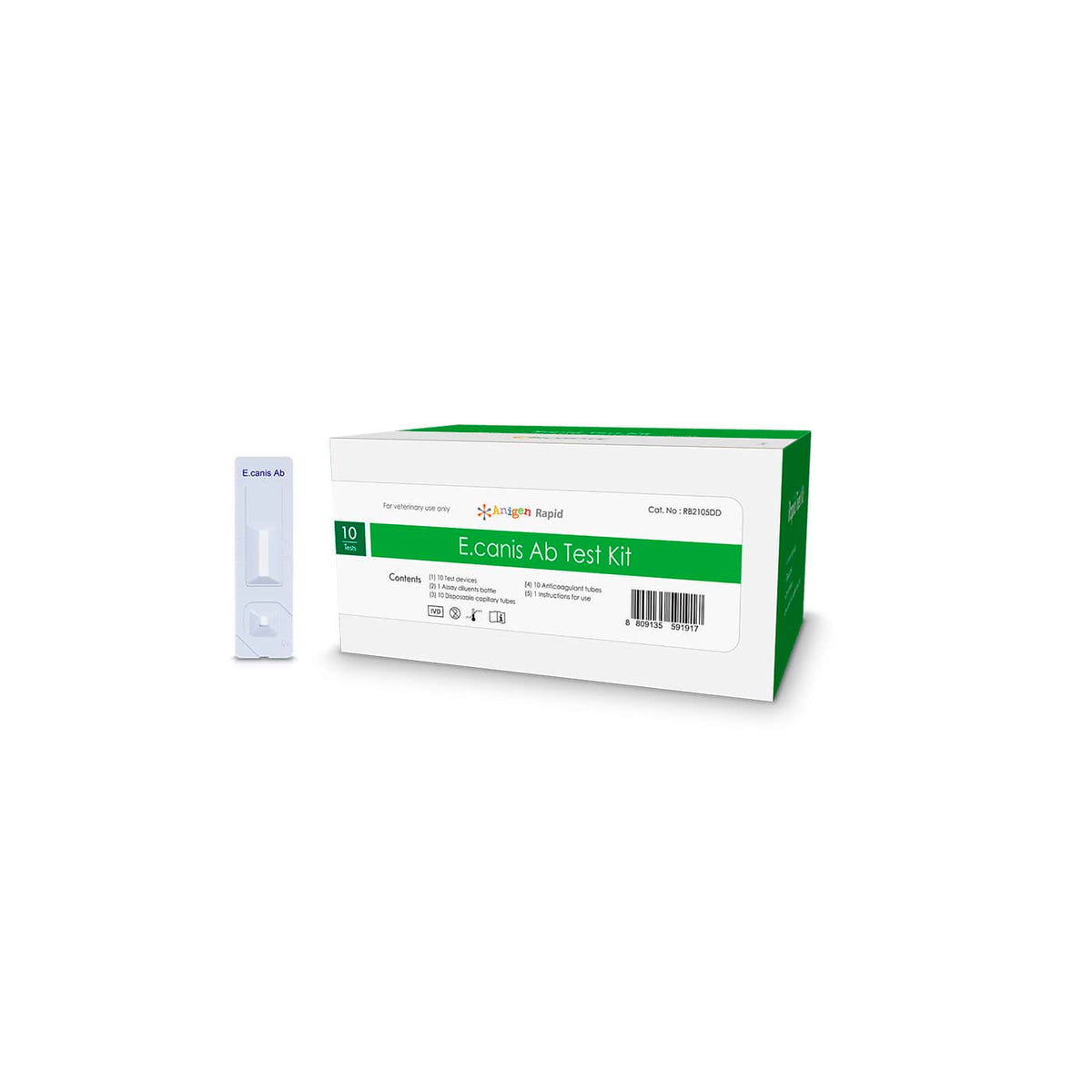
The BIONOTE Anigen Rapid E.canis Ab Test Kit is a rapid immunochromatographic veterinary diagnostic test designed for the qualitative detection of Ehrlichia canis antibodies in canine samples.
Ehrlichia canis is a tick-borne bacterium associated with canine ehrlichiosis, an infectious disease that can affect dogs and may be associated with a range of clinical signs.
The Anigen Rapid E.canis Ab provides a convenient method for detecting antibodies associated with exposure to Ehrlichia canis. The test can be performed using canine whole blood, serum, or plasma, making it suitable for veterinary clinical screening.
BIONOTE describes the product as a chromatographic immunoassay and lists a testing time of approximately 20 minutes.
Key Features
- Detects Ehrlichia canis antibodies
- Designed specifically for dogs
- Suitable for whole blood, serum, or plasma
- Rapid chromatographic immunoassay
- Results in approximately 20 minutes
- Convenient veterinary point-of-care format
- No additional analyzer required
- Suitable for veterinary screening and clinical evaluation
- 10 tests per kit
What Does This Test Detect?
The test detects antibodies against Ehrlichia canis.
Because this is an antibody test, it detects the dog's immune response rather than directly detecting the organism itself. Results should therefore be interpreted by a veterinarian together with the dog's clinical history, physical examination, and other diagnostic findings.
Product Specifications
| Specification | Details |
|---|---|
| Brand | BIONOTE |
| Product Line | Anigen Rapid |
| Product Name | Rapid E.canis Ab |
| Product Type | Veterinary Rapid Diagnostic Test |
| Product No. | RB2105DD |
| Animal | Dog |
| Target | Ehrlichia canis antibody |
| Test Type | Antibody detection |
| Sample | Whole blood, serum or plasma |
| Test Method | Chromatographic immunoassay |
| Testing Time | Approximately 20 minutes |
| Storage Temperature | 2–30°C |
| Package Size | 10 Tests/Kit |
The official BIONOTE product page confirms the product number, 10-test package, storage temperature, target and sample types.
Sample Types
The test is designed for:
- Canine whole blood
- Canine serum
- Canine plasma
BIONOTE's instructions specify canine whole blood, serum, or plasma for the test.
General Test Procedure
The general procedure includes:
- Bring the test components and sample to room temperature before testing.
- Place the test device on a clean, flat surface.
- Apply the specified quantity of canine sample to the sample hole.
- Add the required amount of assay diluent.
- Allow the sample to migrate through the test device.
- Read and interpret the result at the specified time.
BIONOTE's instructions for the related E.canis/Anaplasma antibody format specify 10 µL of sample and 3 drops of assay diluent, with interpretation at 10 minutes for that product. Because your product is the standalone Rapid E.canis Ab, use the current Instructions for Use supplied with your specific kit for the exact volume and reading time.
Result Interpretation
Negative
Only the control line (C) appears.
Positive
Both the control line (C) and test line (T) appear, indicating the presence of target antibodies.
Invalid
The control line does not appear. The test should be repeated with a new test device.
The control line must appear for the test to be considered valid.
Storage
Store at 2–30°C.
Do not freeze.
Keep the test protected from direct sunlight and follow the storage conditions stated on the product packaging and manufacturer's Instructions for Use.
Intended Use
For veterinary diagnostic use only.
The test is intended for the qualitative detection of Ehrlichia canis antibodies in canine whole blood, serum, or plasma.
Important Notes
- For veterinary use only.
- For canine use only.
- This is an antibody detection test, not a direct antigen test.
- A positive antibody result should be interpreted in conjunction with the dog's clinical signs and other diagnostic findings.
- A single test result should not be used as the sole basis for a definitive diagnosis.
- Additional clinical or laboratory testing may be required when results are questionable.
- Do not reuse test components.
- Do not use the test after its expiration date.
- Do not use the kit if the test pouch is damaged or improperly sealed.
- Handle all biological samples as potentially infectious and follow appropriate laboratory safety procedures.