
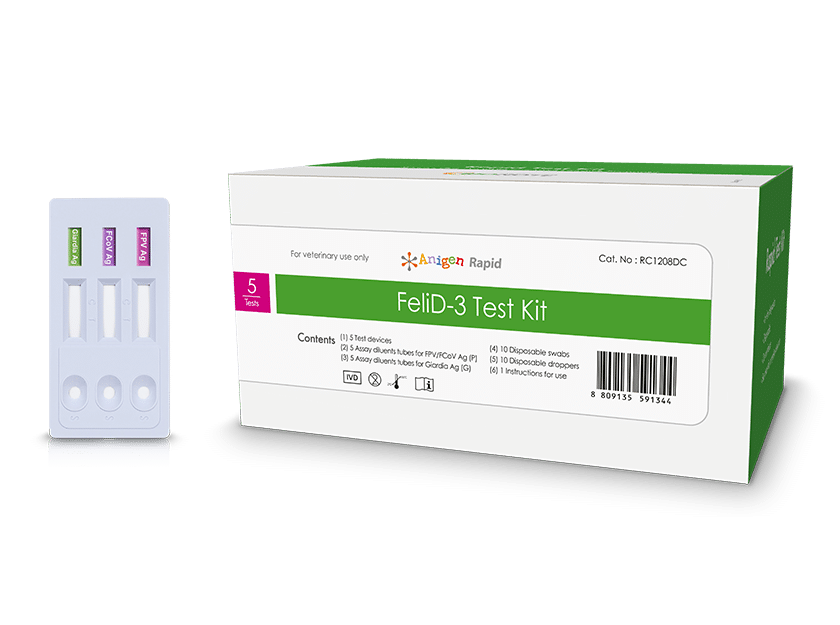

Description
Description
The BIONOTE Anigen Rapid FeliD-3 Ag is a veterinary rapid diagnostic test designed specifically for cats.
The test uses a chromatographic immunoassay to qualitatively detect three important pathogens in feline fecal specimens:
- Feline Panleukopenia Virus (FPV) antigen
- Feline Coronavirus (FCoV) antigen
- Giardia antigen
The FeliD-3 uses a Triple Device configuration, with separate test areas for FPV/FCoV and Giardia detection. It is designed as a convenient one-step screening solution for veterinary clinics.
Key Features
- 3-in-1 feline infectious disease screening
- Detects FPV, FCoV, and Giardia antigens
- Triple Device format
- Designed specifically for cats
- Uses feline feces
- Immunochromatographic assay
- Results in approximately 10 minutes
- Simple visual interpretation
- 5 Tests/Kit
- Storage at 2–30°C
- Veterinary diagnostic use
What Does It Detect?
| Target | Marker | Associated Condition |
|---|---|---|
| Feline Panleukopenia Virus (FPV) | Antigen | Feline panleukopenia |
| Feline Coronavirus (FCoV) | Antigen | Feline coronavirus infection |
| Giardia | Antigen | Giardiasis |
Product Specifications
| Specification | Details |
|---|---|
| Brand | BIONOTE |
| Product Name | Anigen Rapid FeliD-3 Ag |
| Product No. | RC1208DC |
| Test Type | 3-in-1 antigen test |
| Method | Immunochromatographic assay |
| Animal | Cat |
| Specimen | Feline feces |
| Targets | FPV Ag / FCoV Ag / Giardia Ag |
| Device Format | Triple Device |
| Testing Time | Approximately 10 minutes |
| Pack Size | 5 Tests/Kit |
| Storage | 2–30°C |
| Intended Use | Veterinary diagnostic use |
BIONOTE's official product page identifies RC1208DC as the product number and 5 Tests/Kit as the package unit.
Sample Type
Specimen: Feline feces.
Samples should preferably be tested immediately after collection. If testing is delayed, the BIONOTE IFU specifies refrigeration at 2–8°C for up to 24 hours; for longer storage, samples can be frozen at −20°C or below according to the IFU.
General Test Procedure
- Collect the feline fecal sample using the supplied swabs.
- Insert the swabs into the appropriate assay diluent tubes.
- Mix the swab thoroughly in the diluent to dissolve the sample.
- Allow large particles to settle.
- Remove the test device from its foil pouch and place it on a flat, dry surface.
- Use the supplied disposable droppers to collect the prepared sample.
- Add 4 drops of the prepared sample to each appropriate sample hole.
- Start the timer.
- Interpret the results at 10 minutes.
- Do not read results after 20 minutes.
Result Interpretation
Negative
Only the appropriate Control (C) line appears.
Positive
A Test (T) line together with the corresponding Control (C) line indicates detection of the respective antigen.
The device can show positive results for:
- FPV Ag
- FCoV Ag
- Giardia Ag
Each target should be interpreted according to the corresponding test area.
Invalid
If the required Control (C) line does not appear, the result is invalid and the sample should be retested using a new test device.
Kit Contents
The 5 Tests/Kit configuration includes:
- 5 × Anigen Rapid FeliD-3 test devices
- FPV/FCoV Ag assay diluent tubes
- Giardia Ag assay diluent tubes
- Disposable swabs
- Disposable droppers
- Instructions for Use
Storage & Handling
- Store at 2–30°C
- Do not freeze the test kit
- Keep away from direct sunlight
- Test devices are sensitive to humidity and heat
- Remove the test device from its foil pouch immediately before use
- Do not reuse test components
- Do not use after the expiration date
- Do not use if the pouch is damaged or the seal is broken
- Do not mix components from different lot numbers
- Handle all specimens as potentially infectious
Important Diagnostic Note
The FeliD-3 Ag is intended for primary antigen screening. A test result should not be used as the sole basis for a definitive diagnosis. BIONOTE notes that additional clinical or laboratory testing may be required when results are questionable, and final diagnosis should be made by a veterinarian after considering the complete clinical and laboratory picture.