
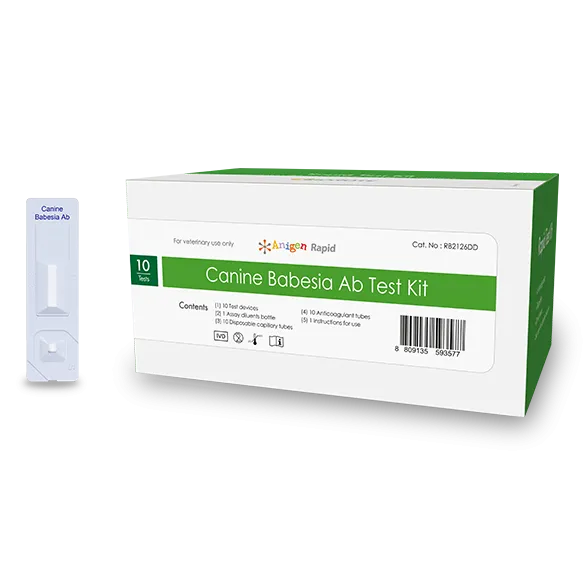

Description
The BIONOTE Anigen Rapid Canine Babesia Ab Test Kit is a rapid immunochromatographic veterinary diagnostic test designed to qualitatively detect antibodies against Babesia gibsoni in dogs.
Babesia gibsoni is a tick-borne protozoan parasite that can cause canine babesiosis. Detection of antibodies can support the veterinary assessment of dogs suspected of exposure or infection.
The test can be performed using canine whole blood, serum, or plasma and provides a rapid screening result without requiring specialized laboratory equipment.
According to BIONOTE, the test uses an immunochromatographic assay and is designed as an auxiliary diagnostic test. Results are available in approximately 15 minutes.
Key Features
- Rapid detection of Babesia gibsoni antibodies
- Designed for dogs
- Suitable for whole blood, serum, or plasma
- Immunochromatographic assay
- Results in approximately 15 minutes
- Convenient rapid-test format
- No additional analyzer required
- Suitable for veterinary clinical screening
- Designed for qualitative antibody detection
What Does This Test Detect?
The test detects antibodies against Canine Babesia gibsoni.
Unlike an antigen test, this product detects the dog's immune response to B. gibsoni, rather than directly detecting the parasite itself.
Product Specifications
| Specification | Details |
|---|---|
| Brand | BIONOTE |
| Product Line | Anigen Rapid |
| Product Name | Rapid Canine Babesia Ab |
| Product Type | Veterinary Rapid Diagnostic Test |
| Product No. | RB2126DC |
| Animal | Dog |
| Target | Babesia gibsoni antibody |
| Test Type | Antibody detection |
| Sample | Whole blood, serum or plasma |
| Test Method | Immunochromatographic assay |
| Testing Time | Approximately 15 minutes |
| Storage Temperature | 2–30°C |
| Package Size | 5 Tests/Kit |
BIONOTE's official product page lists RB2126DC, 5 Tests/Kit, 2–30°C storage, and canine whole blood, serum or plasma as specimen types.
Sample Types
The test can be performed using:
- Whole blood
- Serum
- Plasma
For whole blood testing, BIONOTE's instructions specify anticoagulated blood.
Kit Contents
The BIONOTE brochure identifies the following supplied materials:
- Anigen Rapid Canine Babesia Ab test device
- Assay diluent
- Anticoagulant tube
- Disposable capillary tube
General Test Procedure
The general procedure is:
- Collect the appropriate canine blood sample.
- Place 10 μL of whole blood, serum, or plasma onto the sample hole of the test device.
- Add 3 drops of assay diluent.
- Allow the test to develop.
- Read the result at approximately 15 minutes.
BIONOTE's instructions specify reading the result at 15 minutes and not interpreting test lines appearing after 25 minutes.
Always follow the current Instructions for Use supplied with the product for the exact procedure and interpretation.
Result Interpretation
Negative
Only the control line (C) appears.
Positive
Both the control line (C) and test line (T) appear.
Invalid
The control line does not appear. The test should be repeated using a new device.
BIONOTE's instructions specify that a valid test must show the control line.
Storage
Store the kit at 2–30°C.
Do not freeze the kit. Keep the test device sealed until immediately before use and follow the manufacturer's storage instructions.
Intended Use
For veterinary diagnostic use.
The test is intended as an auxiliary screening test for the qualitative detection of antibodies against Babesia gibsoni in canine whole blood, serum, or plasma.
Important Notes
- For veterinary use only.
- Intended for use in dogs.
- This is an antibody detection test, not a direct parasite antigen test.
- A positive antibody result may indicate exposure or infection and should be interpreted together with clinical signs and other diagnostic findings.
- The test should not be used as the sole basis for a definitive diagnosis.
- False-positive and false-negative results cannot be completely excluded.
- If clinical signs persist despite a negative result, additional diagnostic testing may be required.
- Follow the manufacturer's current Instructions for Use.
BIONOTE specifically describes the product as an auxiliary diagnostic test and notes that the result should not be used as the sole basis for final diagnosis.